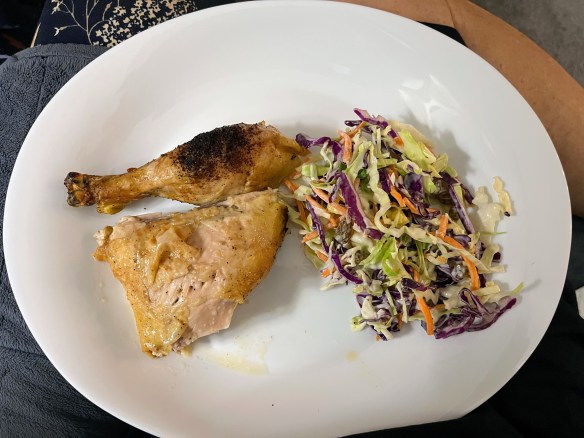
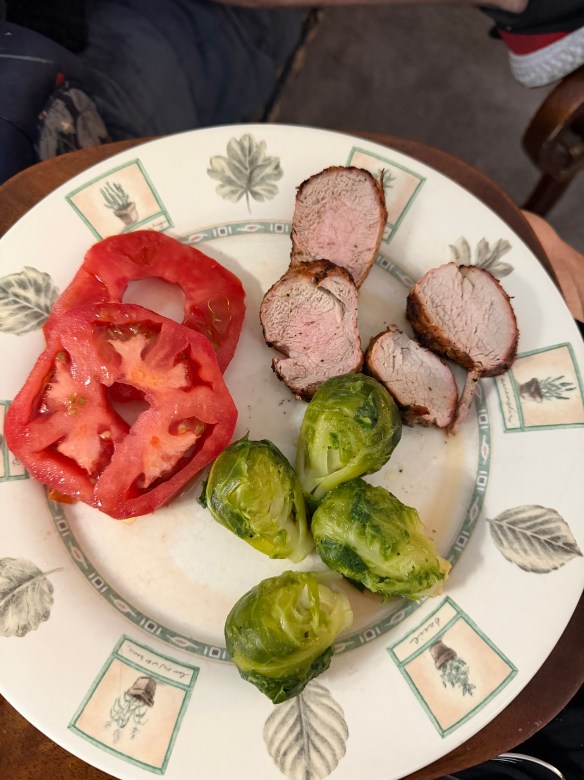
the uncrowded plate

Like a lot of folks in the digital era where most of us have a camera surgically attached to our wrist as part of a dizzying array of apps built into our smart phones, I take lots of pictures of food.

Or, at least I did.

It can be obnoxious to make a thing of styling your plate and photographing it when you’re at a public restaurant. I’ve seen them. You don’t want to be that person. I’ve taken quick little snaps in restaurants here and there, but never that. The late Stephen Covey, author of 7 Habits of Highly Effective People, is attributed with saying, “The main thing is to keep the main thing the main thing.” Unless you’re a food critic, the main thing is communing with whoever you’re with when dining out. Even if you’re alone. Show some class.

But at home, especially when I used to blog (see what I did there?) I took a gazillion pictures of “what’s for dinner” and posted many of them into either a category called Mary Beth’s Kitchen or, in later iterations of the blog, The Longleaf Bar & Grill. It was fun. I even posted a series of mini-posts of Thanksgiving dinner prep starting in the wee hours all the way through to “Ta Da!” Readers from as far away as England, Ireland, Wales, Italy, and Ireland checked in and we interactively chatted through the day. High energy times and great memories.

I still take a few pictures of what Buck and I eat for dinner, or sometimes lunch, mainly due to that old habit from the blog years. When I looked at my recent photo gallery, I couldn’t help laughing. Plate after plate, they are all so uncrowded!
Old photos show masses of pasta wound around huge shrimp and scallops, massive salads, a warm baguette with herb-scented olive oil for dipping, maybe even some colorful red and yellow roasted peppers on the plate.

Or if I made a Southern style veggie supper, good God, it would be jam-packed with a baked sweet potato, fresh okra, sliced tomatoes, speckled butter beans, collard greens, turnip roots and, of course, a cast iron skillet full of hot cornbread.

Delicious. Beautiful.

But neither Buck nor I want to eat like that anymore. And I don’t want to cook like that anymore. I don’t know if we just got tired of chewing so much after a lifetime of doing it, or if it’s an awareness that our new way of eating is a better fit for happy longevity warriors such as ourselves.
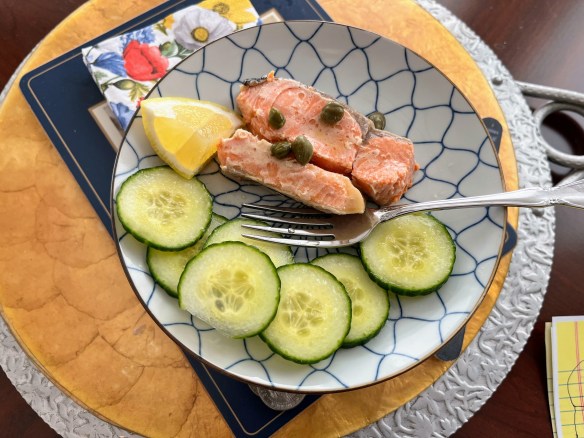
There’s a certain mindful joy to these uncrowded plates, and I’m digging it!
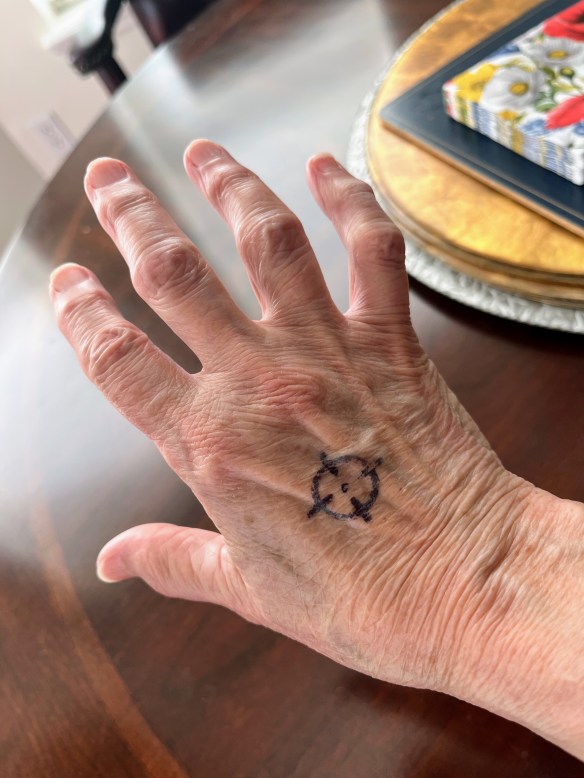
Low Dose Radiation Therapy for Osteoarthritis

Temporary tattoo helps guide the technicians.

For those who believe small talk among strangers in a doctor’s waiting room is a waste of time, consider this: I heard about a non-surgical therapy for osteoarthritis recently approved for use at Mayo Clinic while chit-chatting with a nice woman in the Hearing Clinic there. She was interesting to me because of her knee-high boots with red leather bows on the back, her dramatic hair, and flashing eyes. She exuded positive energy, and I liked her immediately.

Turns out she lives on the beach with her husband and is a retired concert pianist who struggles with hand arthritis. While hearing aid mechanics worked on Buck’s Phonaks, she streamed out a breathy, punctuation-less sentence about signing up for Mayo’s new Low Dose Radiation Therapy treatment for osteoarthritis.

That got my attention.

According to a 2023 article from the Cleveland Clinic, LDRT has actually been around for many decades and was somewhat common in the United States until the 1980’s, when prescription drugs became more prevalent to control arthritis pain.

The process includes one session for a CT mapping of the hands, then six more, spaced out over several weeks, where photons (high-energy light particles) deliver very low doses of radiation that takes about 20 minutes each session, and then you wait about 3 months to find out if it worked to lessen pain and increase flexibility. I understand the same process appears to work well for knee arthritis, too. Some people need a second series for either of them to work. And for a few luckless souls, it never works at all. But there’s no cutting. No down time. And Medicare pays for it.

On the way home from the Hearing Clinic, I sent a note to my primary care doctor to get his opinion. Within a few days, I met with the consulting APRN, who explained it all.

I’m on the other side now, a little over two weeks from the last treatment. Walking into Mayo’s stunning Duan Family Building, which is dedicated to serving patients who need the most complex cancer care, was humbling to say the least. “Yes, I’m just here for my hand arthritis,” I said in a near whisper. During treatment, I couldn’t help but see floor to ceiling open shelves with whole-head radiation masks. The room I was in, the photon machine, the kind team of exquisitely gifted young professionals, all part of the life extending, healing where possible, treatment for brain and other tough cancers. I nearly felt like apologizing for being in that sacred healing space.

All that said, this process of photons delivered to my hands while I was prostrate on my belly on a narrow padded bench, arms stretched over my head like a swimmer, kibitzing with the team and listening to classic rock and roll was weird. It felt like Commander Troy was pointing her tricorder at my fingers, like “There! Now get back to that piano!”

I would say it seems a little smoke and mirror-ish, but Mayo doesn’t dabble in snake handling, (or snake oil, either). I trust them.